Coasts and mountain passes
Haida cooperate with Chinook in shipping, shipbuilding, and rescue. Apsáalooke, Shoshone, and Lakota share pack routes, horse trade, and mountain-pass security.
A TRAVELER’S COMPANION
Follow the rivers. Learn the borders.
Find the places the forest conceals.
Colored territories mark the centers of established fae society. Monochrome wilderness belongs to The Forgotten.
From agayuvik’s snowy coastal bluffs to the cenote city of kuxtal, every region has its own landscapes, crafts, and ways of life.
EXPLORE THE TERRITORIES ↓Nimaamaa takes its name from Ojibwe nimaamaa, “my mother.”
FIFTEEN LANDS. COUNTLESS PATHS.
Choose a territory for its people, settlements, maps, vessels, and defenders.
No territories match your search. Try a people or settlement name.
THE THREADS THAT BIND THE REALM
Nothing in Nimaamaa exists outside the rhythms of the living world. Magic consumes energy. Communities need food, water, shelter, and one another.
Fae reach adulthood at one hundred, when their magic awakens. They may live for two to three thousand years. Aptitude, inheritance, and training shape each individual’s abilities.
Inherited wings emerge at age 100, alongside adulthood and the awakening of magic. All highblood fae have wings; wings also occur among other fae. Wings connect their bearer to ancestral memories. Completely severed wings cannot regrow, and their loss permanently ends that ancestral connection. Flight consumes finite energy.
No single ruler governs every territory. Chiefs serve five-hundred-year terms within a system of kinship and elder councils. A chief cannot begin a war without council approval. Each territory maintains a chief, a senior elder, and a general overseeing the territorial military. Highblood houses have their own heads, but ancestry does not automatically confer territorial rule.
Only exceptionally powerful, trained practitioners deliberately open rifts between worlds. Controlled crossings require a known threshold, an anchor, and cooperating spellcasters. The work can exhaust them for days.
Wings emerge at age 100 in fae who inherit them, alongside adulthood and the awakening of magic. All highblood fae have wings. Wings also occur randomly among other fae; not every people or individual is winged. Winged fae often wrap their wings around themselves like cloaks. They can conceal their wings magically, but concealment consumes energy. Flight supports the fae’s own body weight plus an additional load of up to sixty percent of that weight. Damaged wings can be mended and healed like skin. Completely severed wings cannot be reattached and never regrow. Flight draws on the same finite energy that sustains other magic. Wing forms reflect the winds and environment of each territory, helping their bearers move through their home landscapes. Highblood wings are especially elegant; their shapes retain the adaptations of their territory.
Mixed highblood inheritance. When a highblood male has a child with a lowblood fae, the child has a high chance of inheriting highblood wings. Acknowledgment by the highblood parent grants recognition as mixed highblood. The inherited wings exist whether or not that parent acknowledges the child.
Belonging and rejection. Mixed highblood fae often struggle to find acceptance among either group. Highblood parents frequently deny them. Many become wanderers; some seek refuge with Baldwin in Owenvsv, while others end up in the dark forest.
Ancestral memory. Wings connect their bearer to a vast inheritance of memories and knowledge from previous generations. This connection contributes to magical strength and helps explain the power of highblood lineages. Complete severance permanently cuts off access to the lineage’s ancestral memories. The fae retains personal lived memories.
Most winged fae cruise at 15–25 miles per hour and cover 30–60 miles before a substantial rest. Trained couriers extend their range through rest and favorable winds. Mountain and coastal wings handle gusts; woodland wings favor maneuverability. Highblood elegance does not automatically confer greater speed. Minor wing tears heal in two to four weeks; serious damage takes three to six months. Severed wings never regrow.
The right to eat. Every fae has the right to food. Food in cities and towns costs nothing. Fae may hunt anywhere, including across territorial borders, provided the animal is neither fenced nor livestock. This right does not permit taking another person’s kept animals. Clothing, tools, weapons, and other goods cost money; brass coins remain the currency.
Every territory maintains an organized military. Cities with at least 10,000 residents contribute an army force equal to approximately 25–30 percent of their population. City forces form part of their territorial army and are counted once. Smaller towns and villages maintain militias. Each territorial military has one general.
Conscription and mobilization
Military service is compulsory in every territory from age 100 through age 500. Service begins at adulthood, when magic awakens and inherited wings emerge. During militia mobilization, children remain with the elders while every able-bodied adult fights. The army’s city percentage is a force-strength guideline; precise age-cohort counts have not been fixed.
Command and branches
The general oversees the territorial military. The Army Commander directs regular army forces, the Scout Commander directs scout operations, and the Admiral directs the navy. All three report to the general. The chief retains governing authority and requires elder-council approval before beginning a war.
Regular Army. Every ten soldiers report to a sergeant. Every ten sergeants report to a captain. All regular army captains report to the Army Commander. The exact treatment of sergeants and officers within the ten-soldier count remains unassigned.
Scouts. Scouts are the fae’s special forces and make up 25 percent of the territorial army, not an additional force. They usually operate in six-person teams, including the scout sergeant. All scout sergeants report to the Scout Commander, who directs missions and develops strategy. In the field, the sergeant calls the shots and has tactical authority over the team.
Scout duties. Training covers reconnaissance, tracking, survival, infiltration, ambushes, rescue, independent operations, training local militias, and guiding larger forces through unfamiliar terrain. Magic and shapeshifting support these skills where individuals possess them. Scouts work along and within The Forgotten.
Navy. An additional ten percent of each territory’s population serves in the navy. Each ship has a captain and first officer and carries thirty to fifty personnel. Ship captains report to the Admiral, who reports to the general. The Admiral uses the territory’s airship when one is available. Vessel capacity and naval ship complements are separate measures: larger vessels may have spare capacity and smaller couriers are not standard naval crew ships.
City Guard. The City Guard is separate from both the territorial army and navy. Guards are often associated with highblood families and receive the highest level of training, forming elite units. They deploy only with the chieftain; when no chief is in office, the elder council may order deployment. Guard strength has not been assigned.
City army contributions
These forces are included within territorial army totals. The remaining seventy-five percent of an army comprises its regular branch. Army strength outside the named major cities and City Guard numbers remain to be assigned. Scouts cannot be rounded into complete teams until final army establishments are fixed.
| Territory | City | Residents | Army |
|---|---|---|---|
| Yup’ik | agayuvik | 30,000 | 7,500–9,000 |
| Haida | Ḵuyáadang | 25,000 | 6,250–7,500 |
| Chinook | həliʔil | 25,000 | 6,250–7,500 |
| Apsáalooke | chíchaxxa | 25,000 | 6,250–7,500 |
| Anishinaabeg | Anishi | 20,000 | 5,000–6,000 |
| Diné | bihooʼą́ą́ʼii | 20,000 | 5,000–6,000 |
| Aztec | yōliliztli | 20,000 | 5,000–6,000 |
| Veracruz | Esperar | 15,000 | 3,750–4,500 |
| Oaxaca | nadxiee’ lii | 25,000 | 6,250–7,500 |
| Maya | kuxtal | 25,000 | 6,250–7,500 |
| Total | Named fae cities | 230,000 | 57,500–69,000 |
Naval personnel by territory
Naval personnel are additional to army personnel. These totals describe the whole naval service; no allocation between ship crews, shore stations, training, and support has been fixed. They therefore do not establish a ship count.
| Territory | Regional residents | Navy |
|---|---|---|
| Yup’ik | 60,000 | 6,000 |
| Haida | 90,000 | 9,000 |
| Chinook | 135,000 | 13,500 |
| Shoshone | 25,000 | 2,500 |
| Apsáalooke | 100,000 | 10,000 |
| Lakota | 12,000 | 1,200 |
| Anishinaabeg | 120,000 | 12,000 |
| Iroquois | 20,000 | 2,000 |
| Mohegan | 10,000 | 1,000 |
| Cherokee | 40,000 | 4,000 |
| Diné | 80,000 | 8,000 |
| Aztec | 100,000 | 10,000 |
| Veracruz | 75,000 | 7,500 |
| Oaxaca | 75,000 | 7,500 |
| Maya | 125,000 | 12,500 |
| Total | 1,067,000 | 106,700 |
The Forgotten. Applying the same city-army percentage to tuqu would yield 5,000–6,000 troops from 20,000 residents; Owenvsv would yield 17,500–21,000 from 70,000 city residents. These are conditional calculations, not confirmed establishments. The 10,000–15,000 villagers around Owenvsv are additional residents and are not included in its city-army calculation. No territorial naval percentage has been assigned to The Forgotten.
| Class | Cruising speed | Daily range | People, including crew | Cargo allowance |
|---|---|---|---|---|
| Small courier | 25–35 mph | 150–250 miles | 8–20 | 1–3 tons |
| Merchant / patrol | 20–30 mph | 120–200 miles | 30–60 | 5–12 tons |
| Great house flagship | 15–25 mph | 90–160 miles | 80–150 | 15–30 tons |
Cargo allowances assume light occupancy. Passengers, provisions, armor, and weapons reduce available capacity. Ships accommodate fae-sized occupants. Daily ranges include rest and recovery stops; adverse conditions reduce them.
Routine flight lasts four to six hours before landing and recovery. Emergency exertion risks collapse. If both flight officers lose consciousness, the ship falls unless a capable replacement takes over.
Ship weapons combine ballistae, swivel guns, a few heavy cannons, and personal magic. Heavy weapons reduce cargo capacity and maneuverability. Flight officers conserve their strength for the vessel; purpose-built warships carry separate combat spellcasters.
Wing forms follow local winds and environments. The four highblood designs appear across the top of this plate; the folding study shows how wings rest around the body.
THE ROUTES BETWEEN PEOPLES
No current war divides the territories.
Cooperation does not erase disagreement.
Haida cooperate with Chinook in shipping, shipbuilding, and rescue. Apsáalooke, Shoshone, and Lakota share pack routes, horse trade, and mountain-pass security.
Anishinaabeg, Iroquois, and Mohegan exchange medicines and forest products by river. Maya and Veracruz maintain connections through maritime trade, crops, and textiles.
Diné and Oaxaca share highblood diplomacy and magical study. agayuvik welcomes all territories through pilgrimage, scholarship, and mediation.
Aztec and Maya dispute trade tolls and influence while continuing commerce. Apsáalooke and Anishinaabeg disagree over frontier access. Baldwin’s city maintains discreet trade with neighboring fae while distrusting Tuquuq.
SPEECH OF OUR SHARED HOME
The shared language of Nimaamaa.
For trade, travel, diplomacy, and connection.
Hello, friend.
Nara means “speech” and “to speak.” Across the realm, it connects peoples whose regional languages remain alongside it.
Nara is an original fictional language inspired by Anishinaabemowin, Diné bizaad, and Cherokee. Its invented words are not translations from those languages.
The complete working reference includes grammar, dialogue, and the original 75-character writing system. Open a topic below to explore.
Search Nara words or English meanings.
| Nara | Meaning | Word type |
|---|
No matching words. Try a different spelling or word type.
Nara means “speech” and “to speak.” Its formal name is Nara Wenashi, conventionally translated as “speech of our shared home.” Literally, wenashi means “of home”; the sense of sharing belongs to the established name.
| Influence | Creative direction |
|---|---|
| Anishinaabemowin | Vowel length, rich verbs, and animate and inanimate noun classes. |
| Diné bizaad | Verb prefixes, handling verbs, descriptive compounds, and subject–object–verb order. |
| Cherokee | Participant marking, action stages, flowing syllables, and inspiration for a future original syllabary. |
| Vowel | Guide |
|---|---|
| a | ah |
| e | eh |
| i | ee |
| o | oh, without a strong English glide |
| u | oo |
Doubled vowels aa, ee, ii, oo, uu last roughly twice as long. Consonants are h, k, l, m, n, r, s, sh, t, ch, ts, w, y, and ʼ, a brief catch in the throat. The r is lightly tapped; sh, ch, and ts each represent one sound.
Stress usually falls on the second-to-last syllable. Different adjacent vowels form separate syllables unless specified otherwise. Nokai is therefore no-KAH-ee, replacing the earlier NOH-kye guide. Nara begins without meaning-changing tone. Latin spelling accompanies the original script charts later in this reference.
Default order is subject–object–verb. Ara shuuma mira means “The person drinks water.” There are no articles equivalent to “a” or “the.” Descriptive words follow nouns: wena shena, “a small home.” Present descriptions omit “is”: Wena seya, “The home is safe.”
| Pronoun | Meaning | Subject prefix |
|---|---|---|
| ni | I; me | ni- |
| ki | you, singular | ki- |
| a | he; she; that person | none |
| nashi | we, including you | nashi- |
| nami | we, excluding you | nami- |
| kiri | you, plural | kiri- |
| ari | they | ari- |
Nara does not distinguish he and she grammatically. A subject prefix normally makes the separate subject pronoun unnecessary. A separate pronoun adds emphasis. Objects use independent pronouns before the verb.
| Nara | Meaning |
|---|---|
| Nitari. | I travel. |
| Nashitari. | We travel, including you. |
| Ni nitari. | I am the one going. |
| Ki nishara. | I protect you. |
| Ni kishara. | You protect me. |
Build a verb as subject prefix + root + action ending. Time is expressed with separate words.
| Ending | Action | Example |
|---|---|---|
| none | simple or habitual | ninara — I speak |
| -sha | beginning | ninarasha — I begin speaking |
| -wa | continuing | ninarawa — I am speaking |
| -ta | completed | ninarata — I have spoken |
Time words: ena, now; hani, previously; yara, afterward or in the future; sena, today or day; hasena, yesterday; yasena, tomorrow. Yara ki nishara means “I will protect you.” Time words may be omitted once context establishes the time.
Place ma immediately before the verb to negate it: Ma nikena, “I do not know.” Add he at the end for a question: Kikena he?, “Do you know?” Question words remain in the position of the information requested.
| Word | Meaning |
|---|---|
| asha | who |
| tse | what |
| weha | where |
| yane | when |
| tsena | why |
| heshi | how |
Tse kinera he? means “What do you see?” Weha kitari he? means “Where are you going?”
A bare verb commands one person; add -ri to address a group. Tari! means “Go!” Tariri! means “All of you, go!” Ma tari! means “Do not go!” She softens a request: Hara she, “Please wait.”
Nouns are animate or inanimate. People, animals, and spirits are animate; buildings, tools, and ordinary substances are generally inanimate. Enchanted objects receive their class individually. Trees are animate in the starter dictionary.
Animate plurals take -ri: ara → arari, “person → people.” Inanimate plurals take -ni: wena → wenani, “home → homes.” Mass nouns such as water normally remain unpluralized.
Possession adds -shi to the owner before the possessed noun: Nishi wena, “my home”; Kishi keta, “your blade”; Samashi wena, “Sama’s home.” Always append -shi without dropping letters: ni → nishi; ki → kishi; nashi → nashishi, “our including you”; nami → namishi, “our excluding you.”
| Word | Meaning |
|---|---|
| na | at; in |
| ta | to; toward |
| ha | from |
| ne | with; alongside |
| sha | inside |
| ka | above; over |
| nu | below; beneath |
Position words follow their noun or pronoun: Wena ta nitari, “I travel home”; Ki ne nitari, “I travel with you.” Attached endings and separate words remain distinct: -sha begins an action, while sha means “inside.”
A means animate noun; I means inanimate noun; V means verb; D means descriptive word. The revision separates formerly overlapping content roots to improve clarity. Small grammatical words may still have more than one function.
| Root | Meaning | Type |
|---|---|---|
| nara | speak; speech | V / I |
| wena | home | I |
| shuuma | water | I |
| tesha | light | I |
| nokai | darkness | I |
| hawen | wind | I |
| tari | go; travel | V |
| ara | person | A |
| sheni | child | A |
| nema | parent | A |
| meya | mother | A |
| taya | father | A |
| sheri | sibling | A |
| weni | friend | A |
| weri | return | V |
| yena | spirit | A |
| chira | animal | A |
| haya | bird | A |
| kera | tree | A |
| suma | food | I |
| saha | fire | I |
| toma | earth; ground | I |
| toki | close; shut | V |
| kama | stone | I |
| hora | sky | I |
| tsera | star | I |
| noka | night | I |
| numi | sleep | V |
| noki | dark | D |
| sena | day; today | I / time |
| rasha | road; path | I |
| hena | vessel; ship | I |
| keta | blade | I |
| tasha | bow | I |
| chena | arrow | I |
| shuma | cord; rope | I |
| yuma | magic | I |
| naya | name | I |
| Root | Meaning | Type |
|---|---|---|
| nera | see | V |
| hesha | hear; listen | V |
| kena | know | V |
| rema | remember | V |
| shara | protect | V |
| mewa | love | V |
| shala | fear | V |
| ruma | live; be alive | V |
| sumi | eat | V |
| mira | drink | V |
| hara | wait; remain | V |
| tsema | find | V |
| kasha | open | V |
| seya | safe | D |
| kora | strong | D |
| shena | small | D |
| mora | large | D |
| hira | well; greeting | D / expression |
| wera | near | D |
| yora | far | D |
| Root | Object carried | Example |
|---|---|---|
| mera | person or animal | Sheni nimera — I carry the child |
| kata | rigid object | Keta nikata — I carry the blade |
| shuwa | flexible object | Shuma nishuwa — I carry the rope |
| muwa | liquid | Shuuma nimuwa — I carry water |
Shuma, “rope,” and shuuma, “water,” demonstrate the importance of vowel length.
Put the defining root first and the main noun last. Hawenhena means “airship” or “wind vessel”; shuumahena, “watergoing ship”; teshakama, “lightstone”; yumaketa, “enchanted blade”; nokairasha, “dark wilderness path”; wenatesha, “home light,” including a light kept for someone’s return.
Nara uses a base-ten counting system. Numbers precede nouns. A plural ending is optional when a number already establishes quantity: Shaku ara, “four people.”
| Number | Nara | Number | Nara |
|---|---|---|---|
| 0 | osu | 6 | meru |
| 1 | taku | 7 | naru |
| 2 | neku | 8 | kiru |
| 3 | kisu | 9 | sharu |
| 4 | shaku | 10 | tanu |
| 5 | muku | 100 | tama |
Eleven is tanu taku. Twenty is neku tanu. Twenty-four is neku tanu shaku. One hundred is tama; two hundred is neku tama. One thousand is tamu. Read groups from largest to smallest, omitting zero groups: 1,224 is tamu neku tama neku tanu shaku. Use -re on the final number word for an ordinal: neku-re, second.
| Nara | Meaning |
|---|---|
| Hira. | Hello; greetings. |
| Kiruma he? | Are you well? Literally, “Do you live?” |
| Niruma hira. | I am well. |
| Ki nimewa. | I love you. |
| Ki nirema. | I remember you. |
| Wena ta tari. | Go home. |
| Wera hara. | Stay close. |
| Hesha! | Listen! |
| Nokai na ma tari. | Do not go into the darkness. |
| Washi nashitari. | We travel together, including you. |
| Yara niweri. | I will return. |
| Kishi wena seya. | Your home is safe. |
Hira, weni. — Hello, friend.Weha kitari he? — Where are you going?Wena ta nitari. — I am going home.Nokai wera. — The darkness is near.Nikena. Ki ne nitari. — I know. I am going with you.Washi nashitari. — We travel together.
This edition supersedes conflicting rules in the first draft. Possession now always appends -shi. Weri means return, toki means shut, numi means sleep, and noki means dark; weni, toma, and noka retain friend, earth, and night. Revised numerals reduce confusion with pronouns and verbs. Washi explicitly means together.
Nara is deliberately streamlined as a shared language. Animate and inanimate classes determine plurals and dictionary classification but do not currently trigger verb agreement. Handling verbs classify what is carried independently of noun class. There is no obligatory third-person tracking suffix: repeat a name or title when pronouns would be unclear.
Subject prefixes attach directly to roots with no automatic vowel deletion. Permit vowel sequences and nara-specific consonant sequences created across word boundaries. Common roots favor simple syllables; hawen and nokai remain accepted established forms. A written apostrophe marks only an actual glottal stop, never decoration.
| Word | Function | Example |
|---|---|---|
| wa | and | Ni wa ki — you and I |
| se | but | Nikena se ma nitari — I know, but I do not go |
| rane | because | Nihara rane nokai wera — I wait because darkness is near |
| kane | if | Kane nokai wera, wena ta tari — If darkness is near, go home |
| yane | when; at what time | Yane kiweri, ninara — When you return, I speak |
| che | that; introduces a content clause | Nikena che kiweri — I know that you return |
| re | relative clause opener | ara re hawenhena shara — the person who protects the airship |
| yo | relative clause closer | ara re hawenhena shara yo seya — the person who protects the airship is safe |
| nahe | or | shuuma nahe suma — water or food |
Join complete clauses without moving their verbs. In a content clause after che, retain ordinary Nara order. Relative clauses use re … yo immediately after the noun they describe; the missing participant is that noun. Use explicit names whenever the reference might be uncertain. Punctuation marks clause boundaries in manuscript spelling.
Use hira after a verb for “well.” Use hiri after a noun for “good”: ara hiri, a good person. This distinction prevents niruma hira, “I live well,” from being read as “I live a good thing.” The greeting remains Hira.
Mora before a descriptive word means very: mora seya, very safe. Comparisons use the pattern subject + standard + ha + description: Nishi hena kishi hena ha mora, “My ship is larger than your ship.” Equality uses washi before the description: Nishi hena wa kishi hena washi mora, “My ship and your ship are equally large.”
For ability, obligation, or desire, place an uninflected action word before a finite helper verb: tari nishewa, “I can travel”; tari nitema, “I must travel”; tari niyewa, “I want to travel.” Objects and direction phrases precede the action word: wena ta tari niyewa, “I want to go home.” Only the helper takes the subject prefix and action ending.
Negating a helper negates the whole action: tari ma nishewa, “I cannot travel.” To describe a past state, add hani; to describe a future state, add yara. For negative descriptions use ma before the descriptive word: Wena ma seya, “The home is not safe.”
| Form | Meaning | Use |
|---|---|---|
| e / mo | yes / no | Answers to questions |
| cha / chu | this / that | Follow a noun: hena cha, this ship |
| neha / yoha | here / there | Location words |
| washi | together; equally | Before an action, or before a comparative description |
| washa | also; too | At the beginning of the added clause |
| sare | only | Immediately before the restricted word |
| yema | already | Before the verb |
| maye | not yet | Before an affirmative verb; replaces ma |
| naye | again | Before the verb |
| shawe | perhaps | At the beginning of a clause |
Reflexive objects use subject pronoun + -se: nise, myself; kise, yourself; ase, themself; arise, themselves. Ki kise kishara means “You protect yourself.” A reciprocal action uses washe before the verb: Washe nashishara, “We protect one another.”
| Root | Meaning | Type |
|---|---|---|
| shaya | wing | I |
| shayari | winged traveler | A |
| hawi | fly | V |
| kawi | land; alight | V |
| howa | rise; ascend | V |
| nuwi | descend | V |
| hawiha | take flight | V |
| rashi | walk | V |
| tashi | run | V |
| shewa | be able | V |
| tema | must; be obliged | V |
| yewa | want | V |
| henara | captain | A |
| henari | crew member | A |
| henawa | sail | I |
| henaka | deck | I |
| henasha | hold; cargo space | I |
| henashuma | rigging | I |
| kamasha | anchor | I |
| sumiha | provisions | I |
| rashama | journey | I |
| hawora | storm | I |
| shuumara | river | I |
| shuumora | sea | I |
| tomaka | mountain | I |
| kerama | forest | I |
| rashe | bridge | I |
| wenara | settlement | I |
These are shared-language terms, not changes to the world’s physical rules. Shaya names a wing without defining its anatomy. Hawi means flight without establishing speed, endurance, or magic. Henara names a captain without changing who can keep an airship aloft.
| Root | Meaning | Type |
|---|---|---|
| yumara | magic user | A |
| yumi | work magic | V |
| yumashuma | magical bond | I |
| yumashena | spell; deliberate magical working | I |
| wenama | territory; governed land | I |
| wenashiara | envoy | A |
| kerasha | council | I |
| kerashari | council member | A |
| tarama | agreement; treaty | I |
| tarami | agree; consent | V |
| ketara | soldier | A |
| sharara | guard | A |
| sharawena | watch post | I |
| shenaara | stranger | A |
| nashala | danger | I |
| shali | harm; injure | V |
| shumaara | trap | I |
| nerasha | track; trail sign | I |
| nerashi | follow tracks | V |
| heshara | warning | I |
| heshari | warn | V |
| kashama | wound | I |
| kashami | heal | V |
| rumata | death | I |
| rumi | die | V |
Noun class does not decide whether something is conscious, benevolent, or magically powerful. Nokai remains an inanimate mass noun in the shared language; this grammatical choice makes no claim about the darkness’s origin or nature.
| Root | Meaning | Type |
|---|---|---|
| mewara | beloved; partner | A |
| wenira | trusted companion | A |
| nemi | care for | V |
| namiya | family; household | I |
| sharami | trust | V |
| remara | memory | I |
| mewasha | affection; love as a feeling | I |
| shalaru | grief | I |
| shaliha | hurt; be in pain | V |
| heshami | understand | V |
| nerami | learn | V |
| narami | teach | V |
| sumara | meal | I |
| shuumi | wash | V |
| wenami | rest | V |
| hiri | good | D |
| sheriha | kind | D |
| kori | brave | D |
| shaliwe | afraid | D |
| rumiha | tired | D |
| nemiha | hungry | D |
| shuumiha | thirsty | D |
These expressions do not create new family structures or political institutions. They give characters words for relationships and roles already established in the story.
The expressions below are proposed in-world idioms. Their explanations belong to Nimaamaa and do not describe customs of the real languages that inspired this project.
| Nara | Natural meaning | Literal sense |
|---|---|---|
| Hira. | Hello. | Good; well. |
| Nirema. | Thank you. | I remember. |
| Yara ki ma nishali. | I will not hurt you. | Same as the natural translation. |
| Nishalita. | I am sorry. | I have caused harm. |
| Seya tari. | Travel safely; farewell. | Go safely. |
| Yara ni kinera. | You will see me again. | You will see me in the future. |
| Nishi wenatesha. | My home light; my darling. | My light kept for a return. |
| Ki ne nihara. | I am staying with you. | I remain alongside you. |
| Yara niweri. | I promise I will return. | I will return. |
| Nirema wa nishara. | I remember and I protect. | Same as the natural translation. |
| Ma kikena. | You know nothing. | You do not know. |
| Hawen kishi hora na. | Your head is full of wind. | Wind is in your sky. |
Idiomatic translations can carry a conventional implication beyond their literal wording. They must not silently change grammar. The apology, farewell, affectionate address, and insult are conventional in-world usages. They do not represent supernatural promises or newly established customs.
Two unnamed travelers pause on a path. They are dialogue placeholders, not additions to the story’s cast. The exchange tests commands, questions, subject prefixes, helper verbs, and inclusive we.
Hara. Nokai wera. — Wait. The darkness is near.Nikena. Wena ta tari nitema. — I know. I must go home.Ki ne tari niyewa. — I want to travel with you.Ki ne tari nishewa he? — Can I travel with you?E. Washi nashitari. — Yes. We travel together.Nirema, weni. — Thank you, friend.Hesha. Tse kihesha he? — Listen. What do you hear?Ma nikena. Shawe sheni. — I do not know. Perhaps a child.Neha hara she. Yara ninera. — Please wait here. I will look.Ma tari. Washi nashitari. — Do not go. We go together.
Nara now has an original compositional syllabary, documented in the script appendix. Latin transliteration remains the practical form for editable manuscript dialogue. The illustrated glyphs are fixed reference artwork; they do not depend on an installed font.
For fiction, introduce short Nara expressions through action and response. Keep a glossary of every published form. Use longer passages when their meaning is clear from context or an adjacent translation. Preserve established place and personal names; do not retrofit invented etymologies without a separate decision.
This edition is a usable grammar draft, expanded lexicon, and original script reference. Dialect history, sound change, formal legal registers, and more complex embedded clauses remain open. New vocabulary can grow as scenes require it.
Nara uses an original compositional syllabary. Each full character represents one vowel or one consonant followed by a vowel. A consonant skeleton and a vowel mark combine into one written unit. The original charts define 70 short-vowel characters; the l-series supplement adds five, for 75 total, with regular modifications for long vowels and consonants without a following vowel.
The shapes are newly designed for this fictional language. They are not copied from the Cherokee syllabary, Canadian Aboriginal syllabics, or another existing writing system. They use straight strokes suitable for ink, carving, and small inscriptions.
Write horizontally from left to right, then continue on the next line below. Leave a small space between characters and a larger space between words. There are no capital letters. Names use the same characters as ordinary words. Preserve established names in Latin spelling when their sounds fall outside the Nara inventory.
Draw the consonant skeleton first, generally from top to bottom and left to right. Add the vowel mark in the upper-right corner. A rectangular carrier represents a vowel without a preceding consonant. The five vowel marks are a single horizontal stroke for a, two horizontal strokes for e, a vertical stroke for i, a small diamond for o, and a downward chevron for u.
Place two short horizontal strokes at the lower right to lengthen a vowel. To write a consonant with no following vowel, omit the vowel mark and add one horizontal bar beneath the consonant skeleton. The glottal stop has its own skeleton and follows these same rules.
A filled diamond ends a statement or command. Two vertically stacked open diamonds end a question. A short rising slash marks a pause or comma. These marks occupy their own positions after the last character. Use larger spacing to separate paragraphs. Latin transliterations keep ordinary English punctuation for ease of editing.
Write numbers by spelling their Nara names with the same characters. No separate numeral signs are introduced in this edition. Latin digits may be used in working notes, tables, and bilingual maps.
Vowel-only characters and the h, k, m, n, r, and s series. Each column uses the same vowel mark.
Long vowels use the lower-right double stroke. Final consonants use the underline and no vowel mark. All glyph components keep the same orientation; rotation does not change a vowel.
The sh, t, ch, ts, w, y, and glottal-stop series. The apostrophe in Latin transliteration is written as a consonant skeleton in the script.
Long vowels use the lower-right double stroke. Final consonants use the underline and no vowel mark. All glyph components keep the same orientation; rotation does not change a vowel.
Read each inscription from left to right. The Latin line shows the spelling; the segmentation line explains how it divides into characters. Hyphens are teaching aids and are not written in the inscription.
Speech of our shared home | na-ra / we-na-shi
Stay close. | we-ra / ha-ra / statement mark
Water | shuu-ma; the first character carries the length mark
Wind | ha-we-n; the last character is a final consonant
We travel together, including you. | wa-shi / na-shi-ta-ri / statement mark
Use these forms on signs, ship names, letters, maps, and inscriptions. The script records speech; it does not itself carry magical effects. An editable font and handwriting variants are separate future production tasks. Until then, the chart and rendered samples are the authoritative visual reference.
A quick reference for the shared language of Nimaamaa
Use these words for movement, warnings, requests, and everyday responses. Teka means stopping an action or movement. Hara means waiting or remaining in place. Yaki means come; hena retains its established meaning of ship.
| Nara | Pronunciation | Meaning |
|---|---|---|
| Teka! | TEH-kah | Stop! |
| Tari! | TAH-ree | Go! |
| Hara! | HAH-rah | Wait! Stay! |
| Yaki! | YAH-kee | Come! |
| Tashi! | TAH-shee | Run! |
| Rashi! | RAH-shee | Walk! |
| Hawi! | HAH-wee | Fly! |
| Kawi! | KAH-wee | Land! |
| Nera! | NEH-rah | Look! |
| Hesha! | HEH-shah | Listen! |
| Shara! | SHAH-rah | Protect! |
| Kasha! | KAH-shah | Open! |
| Toki! | TOH-kee | Close! Shut! |
| Weri! | WEH-ree | Return! Come back! |
| E. | eh | Yes. |
| Mo. | moh | No. |
| She. | sheh | Please. |
| Nirema. | nee-REH-mah | Thank you. |
| Nara | Meaning |
|---|---|
| Ma tari! | Do not go! |
| Ma hawi! | Do not fly! |
| Wera hara! | Stay close! |
| Neha yaki! | Come here! |
| Hara she. | Please wait. |
| Tariri! | Everyone, go! |
| Tekari! | Everyone, stop! |
A bare verb addresses one person. Add -ri to address a group: teka → tekari. Put ma before a verb for a negative command. She softens a request. E and mo are independent replies; ma is the grammatical word for negation.
A reference for the shared language of Nimaamaa
This supplement records gender words, age terms, family relationships, titles, and ways to identify people in Nara. The vocabulary is invented for the story.
| Nara | Pronunciation | Meaning |
|---|---|---|
| sayi | SAH-yee | woman |
| tori | TOH-ree | man |
| waya | WAH-yah | person of another gender |
| shenayi | sheh-NAH-yee | girl |
| shenori | sheh-NOH-ree | boy |
| ara | AH-rah | person; gender unspecified |
| sheni | SHEH-nee | child; gender unspecified |
| araya | ah-RAH-yah | adult |
| nemara | neh-MAH-rah | elder |
| shenari | sheh-NAH-ree | young person; adolescent |
| shenewa | sheh-NEH-wah | twin |
| shenewari | sheh-neh-WAH-ree | twins |
A remains the general singular pronoun for he, she, or that person. Ari means they. Use a gender word, name, or title when the distinction matters. Gender words do not change verb endings.
| Nara | Meaning |
|---|---|
| Sayi tari. | The woman travels. |
| Tori tari. | The man travels. |
| Ara tari. | The person travels. |
These words identify people; they do not replace Nara’s animate and inanimate noun classes. People take the animate plural ending -ri. Shenewa becomes shenewari, twins.
| Nara | Meaning |
|---|---|
| meya | mother |
| taya | father |
| nema | parent |
| sheri | sibling |
| sherayi | sister |
| sherori | brother |
| shenayi | daughter when a parent relationship is explicit |
| shenori | son when a parent relationship is explicit |
| mewara | beloved; romantic partner |
Append -shi to the owner and place it before the relationship: Nishi sherori means my brother; Nishi shenewa means my twin. Ashi sherori means his or her brother. Context or an explicit name identifies the owner when several people are present.
| Nara | Meaning |
|---|---|
| Henara [name] | Captain [name] |
| Sharara [name] | Guard [name] |
| Ketara [name] | Soldier [name] |
| Yumara [name] | Magic user [name] |
| Nemara [name] | Elder [name] |
| Nara | Meaning |
|---|---|
| sayi kori | the brave woman |
| nishi sherori | my brother |
| ashi shenewa | his or her twin |
| shenewari | the twins |
| ara re hawenhena shara yo | the person who protects the airship |
Names and role titles can replace ambiguous pronouns. Descriptive words follow nouns, while a relative clause uses re … yo immediately after the person being described.
A dialogue reference for the shared language of Nimaamaa
These invented Nara words range from familiar teasing to serious accusations. Delivery and the relationship between speakers determine whether an insult sounds playful or hostile.
| Nara | Pronunciation | Meaning |
|---|---|---|
| Hawara! | hah-WAH-rah | Windbag; someone who talks endlessly |
| Nokenu! | noh-KEH-noo | Fool; someone who refuses to think |
| Naraki! | nah-RAH-kee | Liar |
| Shalori! | shah-LOH-ree | Coward |
| Sumaki! | soo-MAH-kee | Greedy pig; someone who takes more than their share |
| Ketashi! | keh-TAH-shee | Bully; someone who threatens weaker people |
| Remoki! | reh-MOH-kee | Oathbreaker |
| Wenoki! | weh-NOH-kee | Betrayer of those who sheltered them |
| Nara | Meaning |
|---|---|
| Hawen kishi hora na. | Your head is full of wind. |
| Ma kikena. | You know nothing. |
| Sare kinara. | All you do is talk. Literally, “You only speak.” |
| Kori he? | Brave, are you? |
| Tari, hawara. | Get going, windbag. |
| Hara, nokenu. | Wait, fool. |
| Ki naraki. | You are a liar. |
| Ki remoki. | You are an oathbreaker. |
Hawara and nokenu can serve as affectionate teasing between close companions. They can also sound hostile when directed at a stranger or delivered with contempt.
Remoki and wenoki are serious accusations. Remoki charges someone with breaking a promise or oath. Wenoki accuses them of betraying people who offered shelter; it can end a friendship or provoke a fight.
The expression about wind is idiomatic: its literal wording is “Wind is in your sky.” Ma kikena literally means “You do not know”; its stronger insulting sense comes from context. Insults referring to people belong to the animate noun class.
The additions in this section follow Nara’s existing grammar. Some English renderings are conventional idioms; the notes distinguish those from literal translations. Terms of affection do not establish a magical bond.
| Nara | Pronunciation | Meaning |
|---|---|---|
| meyari | meh-YAH-ree | beautiful; lovely |
| korayi | koh-RAH-yee | handsome |
| rewa | REH-wah | miss; long for someone absent |
| nariwa | nah-REE-wah | joke; tease playfully |
| heshika | heh-SHEE-kah | help; assist |
| nuki | NOO-kee | hide oneself |
| nyuma | NYOO-mah | the space behind; rear |
| kashi | KAH-shee | hand; inanimate noun |
| taki | TAH-kee | take; accept a rigid object |
| yoki | YOH-kee | leave an object in place |
| narena | nah-REH-nah | truth; inanimate noun |
| nareni | nah-REH-nee | speak truthfully |
| wenaya | weh-NAH-yah | host; animate noun |
| kashamira | kah-shah-MEE-rah | healer; animate noun |
| sheniya | sheh-NEE-yah | dear one; animate noun |
Ny in nyuma is a sequence of n and y, not a new consonant. In the script it is written as final n followed by yu. Taki is the ordinary command for accepting a hand, blade, or other rigid object; the established carrying verbs remain separate.
| Nara | Meaning |
|---|---|
| Nishi mewara. | My beloved; my partner. |
| Nishi sheniya. | My dear; sweetheart. |
| Nishi wenatesha. | My home light; my darling. |
| Ki meyari. | You are beautiful. |
| Ki korayi. | You are handsome. |
| Ki nimewa. | I love you. |
| Hani ki nirewa. | I missed you. |
| Ki ne nihara. | I am staying with you. |
| Wera yaki she. | Come close, please. |
| Nara | Meaning |
|---|---|
| Narena he? | Really? Literally, “Truth?” |
| Teka! | Enough! Stop! |
| Seya hara. | Stay safe; be careful. |
| Nishaliha. | I hurt; I am in pain. |
| Nariwa ninara. | I am speaking jokingly; I am joking. |
| Nariwa ma ninara. | I am not joking. |
| Niheshami. | I understand. |
| Ma niheshami. | I do not understand. |
| Naye nara she. | Say it again, please. |
| Wera nihara. | I am staying close. |
Nariwa can precede an action as a manner word meaning jokingly. Seya can precede a command with the sense safely. These uses extend existing descriptive words without changing their roots.
| Nara | Meaning |
|---|---|
| Kishi naya tse he? | What is your name? |
| Nishi naya Faith. | My name is Faith. |
| Nishi naya Reid. | My name is Reid. |
| Weha ha kiyaki he? | Where do you come from? |
| Nishi wena yora. | My home is far away. |
| Ni nishi sherori ne nitari. | I travel with my brother. |
| Nami shenewari. | We are twins, excluding the listener. |
| Ki shenaara he? | Are you a stranger? |
The twins use nami, the exclusive we, when introducing themselves to someone else: Nami shenewari, “We are twins.” Nashi shenewari is reserved for one twin speaking to the other. Names outside the Nara sound inventory keep their established spelling.
| Nara | Meaning |
|---|---|
| Heshika! | Help! |
| Ni heshika! | Help me! |
| Nuki! | Hide! |
| Nukiri! | Everyone, hide! |
| Kishi nyuma na! | Behind you! |
| Yoki! | Leave it where it is! |
| Nishi kashi taki! | Take my hand! |
| Ma nera! | Do not look! |
| Ma nara! | Do not speak! |
| Neha yaki! | Come here! |
| Wena ta tashi! | Run home! |
| Nashala! | Danger! |
Kashi is hand; kasha is open. The final vowel matters. Nuki means hide oneself, so the command does not need a reflexive pronoun. Nyuma is a location noun and takes possession: kishi nyuma na, “at your rear.”
Sheri means sibling. It can also be offered as a respectful address to someone treated as kin. Faith calling the Lady of the Hanging Hair “Sheri” expresses trust and respect; it does not claim a biological relationship. Capitalize Sheri when it functions as her familiar name in English narration.
| Address | Use |
|---|---|
| Sheri. | Sibling; a respectful kinship address when the relationship supports it. |
| Nemara [name]. | Elder [name]. |
| Kashamira [name]. | Healer [name]. |
| Henara [name]. | Captain [name]. |
| Wenaya. | Host; a courteous address to the person offering hospitality. |
| Shenaara. | Stranger; a neutral identifier that may sound distant as direct address. |
| Nirema, wenaya. | Thank you, host. |
| Nirema, Sheri. | Thank you, sibling; Faith’s respectful familiar address. |
Gender does not change these role titles. Use a name or title whenever a would be ambiguous. Hawara remains the established teasing insult “windbag”; locals may use it for Reid because he talks and jokes so often.
The sound l was missing from the original inventory even though established words such as shala, shali, shaliha, and shalori use it. Pronounce it as the clear l in English leaf. Add l to the consonant inventory. The five l-series characters below complete the script coverage for those words.
Use the same length and final-consonant rules as the original charts. The full inventory is now 75 short-vowel characters: the original 70 plus la, le, li, lo, and lu. The initial charts remain valid.
This volume brings all current Nara material together. The latest possession rule always appends -shi; yaki means come and hena means ship. Sheri is sibling and a respectful kinship address. New words can be added as scenes require them; keep a record of each form and its meaning.
This supplement collects the invented vocabulary developed for action, military life, work, hospitality, and romance. Existing meanings remain in place. Corrected spellings are yashi, heshira, and tseri.
| Nara | Pronunciation | Meaning |
|---|---|---|
| keti | KEH-tee | fight |
| ketsi | KEH-tsee | strike; hit |
| shaki | SHAH-kee | block; parry |
| nuwaka | noo-WAH-kah | dodge |
| ketuma | keh-TOO-mah | attack |
| sharama | shah-RAH-mah | defend |
| rashoki | rah-SHOH-kee | retreat; withdraw |
| katse | KAHT-seh | surrender |
| keshika | keh-SHEE-kah | disarm |
| meraki | meh-RAH-kee | rescue |
| kashama | kah-SHAH-mah | wound; noun |
| kashami | kah-SHAH-mee | heal |
| Nara | Pronunciation | Meaning |
|---|---|---|
| tseki | TSEH-kee | grab; seize |
| yashi | YAH-shee | release; let go |
| katsha | KAHT-shah | push |
| ratsha | RAHT-shah | pull |
| howaki | hoh-WAH-kee | climb |
| tashu | TAH-shoo | jump |
| nuwashi | noo-WAH-shee | crouch |
| rasheni | rah-SHEH-nee | follow |
| tekari | teh-KAH-ree | Everyone, stop! Group command from teka |
| yoki | YOH-kee | leave an object where it is |
| taki | TAH-kee | take; accept a rigid object |
| heshika | heh-SHEE-kah | help; assist |
Use the bare verb to command one person. Add -ri for a group: sharama → sharamari. Put ma immediately before the verb for a negative command.
| Nara | Pronunciation | Meaning |
|---|---|---|
| ketara | keh-TAH-rah | soldier |
| sharara | shah-RAH-rah | guard |
| ketaruma | keh-tah-ROO-mah | army |
| ketarashi | keh-tah-RAH-shee | commander |
| ketareni | keh-tah-REH-nee | officer |
| nerara | neh-RAH-rah | scout |
| heshira | heh-SHEE-rah | messenger |
| ketasha | keh-TAH-shah | combat unit; squad |
| sharawena | shah-rah-WEH-nah | watch post |
| sharako | shah-RAH-koh | shield |
| ketawa | keh-TAH-wah | armor |
| ketahu | keh-TAH-hoo | firearm |
| ketahu kora | keh-TAH-hoo KOH-rah | heavy firearm |
| ketasu | keh-TAH-soo | ammunition |
| ketana | keh-TAH-nah | order; command; noun |
| ketani | keh-TAH-nee | give an order |
| Nara | Meaning |
|---|---|
| wenamashi ketaruma | the territory’s army |
| wenarashi ketaruma | the settlement’s army |
| wenarashi shararari | the settlement’s guards |
These phrases distinguish organizations without changing their established command structure. Heavy firearm is a general category; the phrase does not specify a weapon design.
| Nara | Meaning |
|---|---|
| Ketuma! | Attack! |
| Sharamari! | Everyone, defend! |
| Rashokiri! | Everyone, retreat! |
| Nishi kashi yashi! | Let go of my hand! |
| Ni rasheni! | Follow me! |
Kashi means hand. Tekari is already an inflected group command, not a separate verb root; its singular command is Teka!
| Nara | Pronunciation | Meaning |
|---|---|---|
| wemi | WEH-mee | serve; provide a service |
| wemara | weh-MAH-rah | service worker; attendant |
| temi | TEH-mee | work; verb |
| temara | teh-MAH-rah | worker |
| sumira | soo-MEE-rah | cook; person who prepares food |
| sumiri | soo-MEE-ree | cook; prepare food; verb |
| wenaya | weh-NAH-yah | host |
| wenayu | weh-NAH-yoo | guest |
| kashamira | kah-shah-MEE-rah | healer |
| narami | nah-RAH-mee | teach |
| naramira | nah-rah-MEE-rah | teacher |
| tseri | TSEH-ree | give |
| temaki | teh-MAH-kee | repair |
| sumara | soo-MAH-rah | meal |
Wemi describes providing service; it does not imply slavery or ownership. Role words such as wemara, sumira, and naramira identify people and take the animate plural ending -ri.
| Nara | Meaning |
|---|---|
| Shuuma tseri she. | Give water, please. |
| Nirema, wenaya. | Thank you, host. |
| Hara she. | Please wait. |
| Ni heshika she. | Please help me. |
She softens a request. Nirema is the established expression for thank you, literally “I remember.” Requests do not imply that food or hospitality must be purchased.
Use established subject prefixes with the new verbs: ni- for I, ki- for you, nashi- for we including you, nami- for we excluding you, kiri- for you plural, and ari- for they. A third-person singular verb has no subject prefix.
| Nara | Meaning |
|---|---|
| Nitemi. | I work. |
| Kitemaki. | You repair. |
| Sumara nisumiri. | I prepare a meal. |
| Shuuma nitseri. | I give water. |
| Nara | Pronunciation | Meaning |
|---|---|---|
| mewa | MEH-wah | love; verb |
| mewara | meh-WAH-rah | beloved; romantic partner |
| mewasha | meh-WAH-shah | love; affection as a feeling |
| meyari | meh-YAH-ree | beautiful |
| korayi | koh-RAH-yee | handsome |
| sheniya | sheh-NEE-yah | dear one; sweetheart |
| rewa | REH-wah | miss; long for someone absent |
| meyaki | meh-YAH-kee | kiss; verb |
| mewaki | meh-WAH-kee | embrace; hug |
| kashine | kah-SHEE-neh | hold hands |
| sharami | shah-RAH-mee | trust; verb |
| meyuma | meh-YOO-mah | desire; romantic longing; noun |
| meyumi | meh-YOO-mee | desire someone; verb |
| mewena | meh-WEH-nah | marriage; committed union |
| meweni | meh-WEH-nee | marry |
| wenatesha | weh-nah-TEH-shah | home light; affectionate darling |
| Nara | Meaning |
|---|---|
| Ki nimewa. | I love you. |
| Ki nisharami. | I trust you. |
| Ki nimeyumi. | I desire you. |
| Ki meyaki nishewa he? | May I kiss you? Literally, “Can I kiss you?” |
| E. Ni meyaki. | Yes. Kiss me. |
| Mo. Teka. | No. Stop. |
| Ki mewaki niyewa. | I want to hold you. |
| Ki ne kashine niyewa. | I want to hold hands with you. |
| Nishi wenatesha. | My darling. |
For ability or desire, the action stays uninflected and the helper carries the subject prefix: meyaki nishewa, “I can kiss”; mewaki niyewa, “I want to embrace.” The object ki before the action means you.
Use a bare verb for one person. Add -ri for a group. Put ma immediately before the verb for a negative command. She softens a request.
| Nara | Meaning | Nara | Meaning |
|---|---|---|---|
| Teka! | Stop! | Ratsha! | Pull! |
| Tari! | Go! | Howaki! | Climb! |
| Yaki! | Come! | Tashu! | Jump! |
| Hara! | Wait! Stay! | Nuwashi! | Crouch! |
| Tashi! | Run! | Ketuma! | Attack! |
| Rashi! | Walk! | Sharama! | Defend! |
| Hawi! | Fly! | Shaki! | Block! Parry! |
| Kawi! | Land! | Nuwaka! | Dodge! |
| Nuki! | Hide! | Rashoki! | Retreat! |
| Nera! | Look! | Katse! | Surrender! |
| Hesha! | Listen! | Keshika! | Disarm! |
| Heshika! | Help! | Meraki! | Rescue! |
| Tseki! | Grab! | Kasha! | Open! |
| Yashi! | Release! Let go! | Toki! | Close! |
| Katsha! | Push! | Weri! | Return! |
| Nara | Meaning |
|---|---|
| Ni rasheni! | Follow me! |
| Ni heshika! | Help me! |
| Neha yaki! | Come here! |
| Wera hara! | Stay close! |
| Nishi kashi taki! | Take my hand! |
| Ma tari! | Do not go! |
| Ma nara! | Do not speak! |
| Hara she. | Please wait. |
| Tekari! | Everyone, stop! |
| Sharamari! | Everyone, defend! |
Nemawena — neh-mah-WEH-nah — is Nara’s name for Skeleton House, the ancestral home where the dead gather. It combines nema, parent, with wena, home. Its literal sense is “home of the forebears.”
Nemawenashi means “of Nemawena.” The revised oath line is Nemawenashi wenamorani na, “In the halls of Skeleton House.” This replaces the earlier mixed English and Nara wording.
Lo, there do I see my father.
Lo, there do I see my mother.
And my sisters and my brothers.
Lo, there do I see the line of my people,
Back to the beginning.
Lo, they do call to me.
They bid me take my place among them,
In the halls of Skeleton House,
Where the brave may live forever.
Yoha nishi taya ninera.
Yoha nishi meya ninera.
Wa nishi sherayiri wa nishi sheroriri.
Yoha nishi ararishi nemarasha ninera.
Tsewa ta.
Yoha ni ariheshena.
Ari nane nishi wenaka taki nitema.
Nemawenashi wenamorani na.
Yoha arari kori rumaya ruma arishewa.
Translation note: This is the ceremonial adaptation developed in our discussion. The seventh Nara line means “I must take my place among them.”
| Nara | Meaning |
|---|---|
| Nemawena | Skeleton House; ancestral home of the dead |
| Nemawenashi | of Nemawena |
| nemarasha | ancestral line; lineage |
| tsewa | beginning; origin |
| heshena | call; summon |
| wenaka | place; appointed position |
| nane | among |
| wenamora | great hall |
| wenamorani | great halls; inanimate plural |
| rumaya | forever; without end |
The possessive ending -shi attaches to the owner: Nemawena → Nemawenashi. Inanimate plural -ni gives wenamora → wenamorani. The position word na follows the location. Together, Nemawenashi wenamorani na means “in the halls of Nemawena.”
Nishi means my. Taya means father; meya means mother. Sherayiri and sheroriri are the animate plurals of sister and brother. Ninera means I see, using ni- with nera.
The root ruma means live. Arishewa means they can or they may, using ari- with shewa. The closing line expresses the brave being able to live forever.
The following sections add working Nara vocabulary for the English lists supplied for this update. New forms are original fictional coinages. Existing roots and grammar remain in use; related English words may share a root or use a descriptive phrase. These additions do not create new story events or magical rules.
Read the combined volume in three parts: the original grammar and script reference, the earlier vocabulary and ceremonial additions, and this descriptive and structural expansion. Established terms repeated here keep their earlier meanings.
Descriptions follow nouns: wena shena, a small home. Present descriptions need no word for is: Wena shena, the home is small. Put ma before a description to negate it. Mora before a descriptive word intensifies it: mora shena, very small or tiny. The same word may describe a manner of action where context is clear, following the established uses of hira and seya.
For a precise sensory distinction, nera remains see and the familiar command look; neraki adds look deliberately or inspect. Hesha remains hear or listen; heshaki specifies listen attentively. These additions refine meaning without replacing established dialogue.
Pukwu is Varek’s nickname for Talven, shortened from Pukwudgie. It does not mean little show off. Hawara remains windbag and the nickname used for Reid. Nemawena is Skeleton House; Nemawenashi is its possessive form, of Nemawena.
Use the existing vowel values and penultimate stress. Double vowels remain long. Separate words remain separate when combined in descriptive phrases. No new sound or script character is introduced by this expansion.
Color words follow the object. Tesha remains the noun light; the following descriptions distinguish brightness, visibility, and color.
| English meaning | Nara |
|---|---|
| radiant; luminous | teshari |
| bright | teshi |
| dazzling | teshi mora |
| shimmering | teshiri |
| dusky | noki shena |
| murky | nokwashi |
| dark | noki |
| dull; lacking shine | teshoki |
| red | rake |
| crimson | rake noki |
| amber colored | saheri |
| orange | sahake |
| yellow | senake |
| green | kerake |
| blue | horake |
| purple | nokare |
| white | weneke |
| black | nokake |
| brown | tomake |
| gray | kamake |
| gold colored | senake teshiri |
| silver colored | kamake teshiri |
Kera kerake — a green tree. Shuuma nokwashi — murky water. Tsera teshiri — a shimmering star. Color compounds here describe appearance, not material: gold colored does not mean made of gold.
Mora and shena remain large and small. Size words describe scale; a separate adjective describes strength, weight, or shape.
| English meaning | Nara |
|---|---|
| big; large | mora |
| small; diminutive | shena |
| enormous; colossal; mammoth; massive | mora mora |
| tiny; minuscule | mora shena |
| hulking | mora wa kora |
| compact | moruki |
| heavy in weight | kamori |
| light in weight | kameni |
| tall | howari |
| short in height | nuwari |
| long | rashaya |
| short in length | rashuki |
| slender | rayeni |
| wide; broad | rayora |
| narrow | rayuki |
| round | koroma |
| square | katoma |
| triangular | kisuma |
| flat | kateni |
| crooked | rashali |
| straight | rashari |
| curved | koreni |
| jagged | keteki |
Ara howari — a tall person. Keta kameni — a light blade. Kora still means strong; the established military phrase ketahu kora remains heavy firearm and does not become a statement of weight.
Use these descriptions for people, objects, buildings, and landscapes as their meanings permit.
| English meaning | Nara |
|---|---|
| majestic | koramora |
| bleak | nokari |
| idyllic; peaceful and beautiful | meyari wa senemi |
| chaotic; disordered | rashoko |
| sprawling | rashamora |
| desolate; abandoned and empty | wenokiha |
| opulent; richly furnished | wenamori |
| beautiful; gorgeous | meyari |
| handsome | korayi |
| ugly | meyoki |
| plain; unadorned | meyeni |
| neat; orderly | rashare |
| messy | rashoko |
| clean | shuumiri |
| dirty | tomari |
| broken | ketoki |
| damaged | shaliki |
| fresh | senayi |
| wet | shuumeyi |
| dry | shuumoki |
| old; aged | nemayi |
| young | sheneyi |
| new | seneki |
| ancient | nemayi mora |
| modern; of the present age | ena senashi |
Ena senashi means of the present day and supplies the sense modern. Old and ancient describe age; they do not by themselves imply decay.
Sound verbs can be inflected normally. Descriptive phrases follow the sound or object they describe.
| English meaning | Nara |
|---|---|
| whisper | narushi |
| hum | heshumi |
| murmur | narumi |
| lilt; melodic rise and fall | heshaya |
| whimper | shalushi |
| crash; make a crashing sound | katseri |
| roar | heshora |
| scream | heshali |
| soft; gentle in sound | heshene |
| muffled | heshuki |
| loud; booming | heshori |
| shrill; piercing | heshiki |
| deafening; thundering | heshori mora |
| quiet | heshene |
| silent | heshoki |
| melodic | heshayi |
| harsh in sound | heshakiha |
| smooth; slick | kamiri |
| soft to touch; feathery | shayeni |
| velvety | shayeni mora |
| silken | shumiri |
| supple; pliable | shumeyi |
| coarse; rough | kamaki |
| hard; rigid | kamari |
| brittle | keteyi |
| weathered | hawenari |
| prickly | cheneyi |
| sticky | shumaki |
| crisp in texture | ketiri |
| bumpy | kamora |
Ninarushi — I whisper. Nishi kashi kamari — my hand is hard. Heshaki means listen attentively; heshakiha is the separate description harsh sounding.
These are descriptions rather than commands. Suma means food; sumiri remains the verb cook.
| English meaning | Nara |
|---|---|
| sweet | sumeyi |
| sour; tangy | sumeki |
| salty | sumari |
| bitter | sumoki |
| spicy; zesty | sahayi |
| delicious; scrumptious | sumahiri |
| savory | sumori |
| bland | sumeni |
| succulent; juicy | shuumeyi wa sumahiri |
| mouth watering; appetizing | sumanemi |
| aromatic; fragrant | huyari |
| pungent | huyori |
| rancid | huyoki |
| acrid | huyaki |
| smell; perceive an odor | huyi |
| scent; odor | huya |
| taste; sample flavor | sumeyiha |
| hot | sahari |
| cold | nokumi |
| warm | saheni |
| cool; chilly | nokuni |
| freezing in temperature | nokumi mora |
| boiling hot | sahari mora |
Redolent of something uses the noun huya with possession: kerashi huya, the scent of a tree. For an object carrying that scent, use a relative clause: shuma re kerashi huya ne yo, a rope with the scent of a tree. Very cold and very hot are descriptive intensifiers, not claims that water is physically freezing or boiling.
These words describe a current feeling or a recurring trait according to context. Kori, sheriha, and shaliwe retain brave, kind, and afraid.
| English meaning | Nara |
|---|---|
| happy; joyful | meweyi |
| exuberant; excited | meweyi mora |
| serene; calm | senemi |
| jovial | nariwayi |
| compassionate | nemiyi |
| intrepid; brave | kori |
| resilient | korumi |
| anxious; nervous | shaleni |
| sad | remuki |
| melancholic | remuki hara |
| cynical | sharamoki |
| sullen | naroki |
| frazzled | temoki |
| forlorn | wenaremi |
| shy | nareniha |
| kind | sheriha |
| honest | narenayi |
| friendly | weniyi |
| rude | narakori |
| smart | kenayi |
| lazy | temeni |
| helpful | heshikayi |
| angry | ketori |
| upset; distressed | shalemi |
| proud | korame |
| afraid | shaliwe |
| tired | rumiha |
Ni shaleni — I am anxious. Faith kori — Faith is brave. Ara nemiyi — a compassionate person. Remuki hara is an idiomatic lingering sadness; hara retains its verb meaning remain.
A means animate and I means inanimate. These are Nara grammar classes, not a scientific classification or a statement about spiritual power. Existing tree and animal classes are preserved.
| English meaning | Nara |
|---|---|
| sun | senera I |
| moon | nokara I |
| star | tsera I |
| sky | hora I |
| earth; ground; land | toma I |
| world | tomawena I |
| water | shuuma I |
| fire | saha I |
| wind | hawen I |
| air | hawena I |
| stone; rock | kama I |
| sand | kamashena I mass |
| mud | shuumatoma I mass |
| tree | kera A |
| grass | kereni A collective |
| plant | keraya A |
| flower | kerameya A |
| animal | chira A |
| fish | shuumachira A |
| bird | haya A |
| mountain | tomaka I |
| river | shuumara I |
| sea; ocean | shuumora I |
| forest; woods | kerama I |
| rain | shuumaha I |
| snow | nokushuuma I |
| cloud | horashuma I |
| leaf | kerashawe I |
These are practical shared language categories. Kerani means multiple trees. Kereni is the collective noun grass despite its final letters; do not parse every word ending in ni as a plural. Use a counted plant noun when individual stems matter.
All forms below are uninflected roots. Use the established subject prefixes and aspect endings. Related English actions may share one root.
| English meaning | Nara |
|---|---|
| run | tashi |
| walk | rashi |
| jump; hop | tashu |
| skip in movement | rashitashu |
| crawl | nuwarashi |
| climb | howaki |
| dance | rashiyi |
| swim | shuumari |
| fly | hawi |
| eat | sumi |
| drink | mira |
| sleep | numi |
| wake; awaken | numeki |
| wash | shuumi |
| cook; bake | sumiri |
| clean | shuumiki |
| read | neranari |
| write | narakiha |
| talk; speak | nara |
| hear; listen | hesha |
| listen attentively | heshaki |
| see; look | nera |
| look deliberately; inspect | neraki |
| watch; keep observing | nerawa |
| sing | narayi |
| laugh | nariyi |
| cry; weep | shalumi |
| smile | meyiri |
Ninarayi — I sing. Shuumara na nishuumari — I swim in the river. Nerawa is the conventional watch form built from nera and the continuing ending; do not treat it as an unrelated root. For baking specifically, saha na sumiri means cook at the fire.
This section completes the handling actions and adds time and age descriptions. Taki continues to mean accept a rigid object; carrying verbs remain distinct.
| English meaning | Nara |
|---|---|
| push | katsha |
| pull | ratsha |
| throw | yashiki |
| catch | tsekira |
| hold; keep in one’s grasp | kashiri |
| open | kasha |
| close | toki |
| build | wenaki |
| fix; repair | temaki |
| cut | ketiriha |
| rapid; swift; fast | tasheni |
| slow | hareni |
| delayed; late | haroki |
| prompt; on time | senari |
| brief; short in duration | senuki |
| annual; every year | sene takuya |
| teenage; adolescent | shenari |
| elderly | nemayi |
| infant; baby | shenuma A |
| year | takuya I |
| month | nokaraya I |
| week of seven days | naru sena |
| soon | yareni |
| later | yara |
| ago; previously | hani |
| then at that time | sena chu na |
Sene is the distributive quantifier every, introduced on the next page. Teenagers may be identified with shenari as a person noun; for precision use ara shenari, an adolescent person. Tomorrow remains yasena and yesterday remains hasena.
Quantity words precede the noun, as numbers do. Nouns remain plural when appropriate; mass nouns normally remain unpluralized. The same quantity root can cover countable and mass uses.
| English meaning | Nara |
|---|---|
| many; much; a lot of; lots of | mori |
| few; little with emphasis on scarcity | shenu |
| a few; a little; some small amount | shenuya |
| several | kisori |
| all; every collectively | seneha |
| each; every individually | sene |
| both | neku seneha |
| some | tseya |
| any in a question or under negation | tseye |
| any at all; whichever freely chosen | tseye sareha |
| most | senehaya |
| enough | temeya |
| plenty of; a great deal of | mori mora |
| half | nekusha |
| no; none; zero amount | osu |
| someone | tseya ara |
| anyone; anybody | tseye ara |
| everyone | seneha arari |
| nobody | osu ara |
| something | tseya tuma |
| anything | tseye tuma |
| everything | seneha tumani |
| nothing | osu tuma |
| thing | tuma I |
| free choice; regardless of which | sareha |
Mori arari — many people. Mori shuuma — much water. Shenu shuuma — little water, scarce. Shenuya shuuma — a little water, some available. Osu ara neha — nobody is here. Osu quantifies a noun; mo answers no and ma negates a verb or description. Tseye is licensed by a question or negative clause; sareha explicitly adds free choice.
Without a noun, a quantity expression refers to a group or substance already mentioned. Repeat the noun whenever all, some, or none would otherwise be unclear.
The independent pronouns serve as subjects and objects. Subject prefixes attach to verbs. He, she, and it use a when context identifies a singular referent; a does not encode gender or animacy.
| English meaning | Nara |
|---|---|
| I; me / you singular | ni / ki |
| he; she; it; him; her | a |
| we; us including the listener | nashi |
| we; us excluding the listener | nami |
| you plural / they; them | kiri / ari |
| my; mine / your; yours singular | nishi / kishi |
| his; hers; its | ashi |
| our; ours including the listener | nashishi |
| our; ours excluding the listener | namishi |
| your; yours plural / their; theirs | kirishi / arishi |
| myself / yourself | nise / kise |
| himself; herself; itself | ase |
| ourselves inclusive / exclusive | nashise / namise |
| yourselves / themselves | kirise / arise |
| this / that | cha / chu |
| these / those | plural noun + cha / chu |
| here / there | neha / yoha |
| nearby / far away; yonder | wera / yora; yoha yora |
| who; whom / what | asha / tse |
| whose | ashashi |
| which | tsecha |
| relative who; which; that | re … yo |
Possessive forms can stand alone when the missing noun is clear: Hena cha nishi, this ship is mine. Emphasis uses an independent pronoun, not an object reflexive: Ni nitari, I myself go. Reflexives remain objects: Ni nise nishara, I protect myself.
Hena tsecha kitaki he — Which ship do you take? Ashashi hena cha he — Whose ship is this? Relative possession uses an explicit possessor inside the clause when necessary; repeat a name to prevent ambiguity. No separate English style whom form is needed.
Use existing Nara structures rather than translating every English helper word separately. Position words follow their noun or pronoun.
| English meaning | Nara |
|---|---|
| in; at; on in contact with | na |
| to; toward / from | ta / ha |
| with; by someone’s side | ne |
| inside / above; over / under | sha / ka / nu |
| for; for the benefit of | nemahe |
| beside; next to | werana |
| outside | shayo |
| out of | shayo ta |
| off; away from a surface | ha |
| up / down as directions | howa ta / nuwi ta |
| and / but / or | wa / se / nahe |
| because / if / when | rane / kane / yane |
| so; therefore | raneya |
| although; even though | kanese |
| that introducing a statement | che |
| not / not yet | ma / maye |
| already / again / also | yema / naye / washa |
| only / perhaps | sare / shawe |
| can; may in the established request pattern | shewa |
| must / want | tema / yewa |
| should; be advisable | temeyi |
Ki nemahe nitemi — I work for you. Kane nokai wera, hara — If darkness is near, wait. Nokai wera; raneya nihara — Darkness is near, so I wait. Kanese nokai wera, nitari — Although darkness is near, I go.
There are no articles a, an, or the. Present be is omitted in descriptions; past or future time uses hani or yara. English do in questions has no separate translation: final he marks the question. English perfect have is usually represented by completed -ta. Possessive have uses the new verb weneyi: Keta niweneyi, I have a blade. Could uses shewa with hani for past ability, or shawe for uncertainty; future will uses yara. These meanings remain distinct.
Time phrases normally precede the clause. Use cha and chu after a time noun or phrase to point to this or that period. Context must identify what a pronoun or pointing word refers to.
| English meaning | Nara |
|---|---|
| now; currently | ena |
| today | sena |
| yesterday / tomorrow | hasena / yasena |
| last night | hani noka |
| this week | naru sena cha |
| next month | yara nokaraya |
| nowadays; in the present period | ena senani na |
| three days ago | kisu sena hani |
| soon / later | yareni / yara |
| at that time; then | sena chu na |
| the former; that previously mentioned | chu re hani ninarata yo |
| the following; this to be said next | cha re yara ninara yo |
| day / night / year / month | sena / noka / takuya / nokaraya |
| where / when / why / how | weha / yane / tsena / heshi |
The discourse expressions above are transparent full phrases meaning that which I said previously and this which I will say afterward. Adapt the person prefix to the speaker of the quoted statement. Cha and chu can refer to an entire statement when context makes it clear; they do not need a new pronoun class.
Shuumara nokwashi. — The river is murky.
Mori arari yoha. — Many people are there.
Shenuya shuuma niweneyi. — I have a little water.
Ki shaleni he? — Are you anxious?
Tasheni tashi! — Run quickly!
Kishi kashi nikashiri. — I hold your hand.
Yareni niweri. — I will return soon.
Yasena wena ta tari nitemeyi. — I should go home tomorrow.
This expansion covers the supplied categories through roots, compounds, and phrases. It preserves the existing writing system and makes no claim that these categories are universal semantic primitives. Further scene specific vocabulary can be added as needed.
| Nara | Natural meaning | Literal sense |
|---|
These are in-world expressions. Their conventional meanings belong to Nimaamaa; they do not establish supernatural promises.
BEYOND THE COLORED BORDERS
The land remembers
what the light has left behind.
Gray wilderness. Damaged waterways. Cities beneath heavy clouds. The darkness wounds the land, but the beings who live here are not all alike: some are peaceful, some unpredictable, and some malevolent.
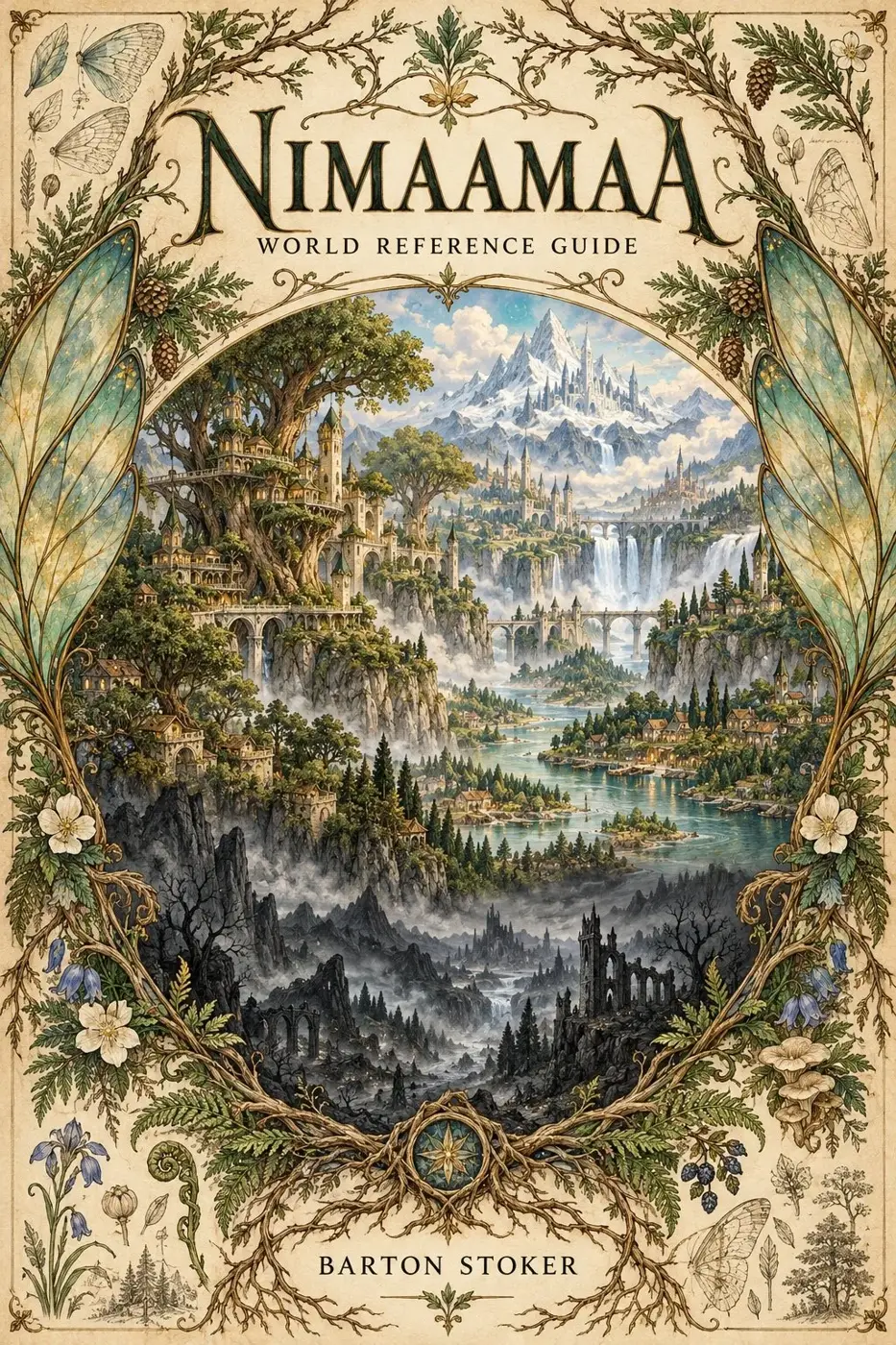
THE WORLD IS ONLY THE BEGINNING
Nimaamaa is the setting of an upcoming book by Barton Stoker. Explore the world here while the story takes shape.
RELEASE DATE TO BE ANNOUNCED
MEET THE AUTHOR ↗Artwork shown: the Nimaamaa World Reference Guide.